
If you run a solo business or a boutique practice, a distinct pattern emerges when daily operations start to feel heavy. It rarely arrives as a single, dramatic catastrophe. Instead, it shows up quietly in your day-to-day routine: answering client emails reactively, jumping from task to task without a clear plan, and realizing you do not have thirty seconds to pause and ask what you actually need for yourself.
When founders find themselves in this place, the default instinct is to turn inward and assign blame. They assume they are disorganized, falling behind, or personally failing to keep up with their company's demands.
I do not refer to my clients as being the bottleneck. Their current system is.
When your operational systems rely on your manual attention to survive every hour of the day, exhaustion is inevitable. The path out of this friction is not about pushing harder or hustling more. It begins by stepping back, grounding your physical reality, and re-engineering your business so it holds its own weight.
The Physical Warning Signs Precede the Calendar Breakdown
Before operational strain shows up on a balance sheet or in a missed deadline, it registers directly in your body. When you operate in continuous reaction mode, your biology carries the load long before your calendar officially breaks.
You might recognize physical cues such as:
- Clenching your jaw during client calls or while reading incoming messages.
- A tight sensation across your chest and shoulders that lingers well into the evening.
- A persistent background hum of urgency, convincing you that every ping requires an immediate reply.
- Mental fatigue that follows you to the dinner table, keeping you mentally preoccupied when you want to be present with the people you love.
When your system spends the entire workday in continuous reaction mode, your brain does not magically power down at bedtime. If you find yourself physically exhausted yet mentally alert late into the evening, this persistent alertness is a clear signal that your brain is carrying daytime operational stress into the night.
The body always tells the truth about workload. When you ignore these physical signals, your executive clear thinking begins to erode.
In my work with founders, our first priority is never to reorganize a calendar or set up complicated software. We begin with biological settling. If you cannot recognize when your system is running on high gear, you cannot make clear, strategic decisions about your enterprise.
Grounding Tools That Put You in Control

To break the habit of chronic reactivity, you need practical moments of physical regulation that fit your day. Grounding belongs to you, happens on your terms, and is designed to be used whenever needed, not just at a morning desk, but quietly in the middle of a high-stakes client meeting.
During our partnership, we explore and brainstorm what physical grounding tools feel right for your specific routine. The purpose of a physical anchor is simple: it interrupts an active stress response, drops physical bracing, and brings your focus back to the present moment.
Examples we often test include:
- Tactile desk anchors: A smooth river stone held in your palm during a tense video call to keep your attention centered.
- Visual living anchors: A small desk plant or greenery placed directly in your line of sight to give your gaze a natural place to rest.
- Sensory reminders: A simple written note attached to your monitor that clarifies your core focus for the day.
- Breathwork sequences: Simple box-breathing methods to settle physical tension before you open a crowded inbox.
Grounding is not a mandatory homework assignment or an elaborate ritual. It is a personalized toolbox of quiet circuit-breakers you can draw from whenever your body signals that tension is rising.
Why the Human Precedes the Business
The foundational work of sustainable leadership requires looking at the person before looking at the company.
In the CEO Wellth Operating System, our first three months focus entirely on the human being, not the business mechanics. By using the Duke Wheel of Health assessment, we step back to evaluate your life as an interconnected whole. We explore your physical environment, rest, relationships, and personal vision.
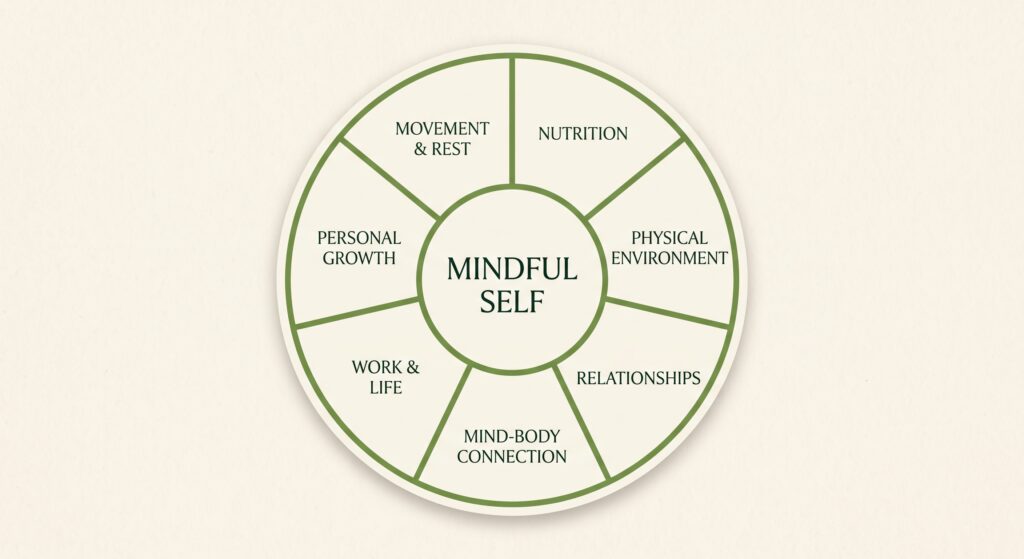
Before you can decide how many hours your company should operate, you need a clear picture of the future self you want to inhabit. Over time, that personal clarity naturally defines how your working hours must change and what your personal definition of enough actually looks like.
A business exists to support your life. When you learn to prioritize your well-being without guilt, the architecture of your business naturally adjusts to protect your health and your personal capacity.
The Mainstream Myth of Hiring and Automation
When solo founders reach a breaking point, conventional business advice prescribes two instant fixes: hire a virtual assistant or automate everything with new software and artificial intelligence.
Both recommendations often introduce significant friction rather than solving it.
There is a widespread misconception that every solo business owner needs an assistant at some point. Yet it is impossible to delegate effectively if you do not have a firm grasp on what you are actually doing in your business, what truly needs to be done, and what ought to be eliminated altogether. If you bring in an assistant without documented, proven processes, that person will ping you constantly for clarification. Instead of gaining freedom, you inherit a second full-time role as an anxious manager.
Turning immediately to artificial intelligence presents the exact same issue. The hours spent configuring prompts, workflows, and automated agents can generate just as much operational drag as managing an untrained contractor.
Before taking on payroll, software subscriptions, or additional management overhead, you need absolute clarity on the daily rhythms you already run.
The "Use What You Got First" Principle and the 72-Hour Hold
Whenever a client feels the urgent impulse to purchase a new software platform or hire support to solve an operational headache, we pause the conversation with a core directive: use what you have got.
We start by asking a grounding question: What will you have this assistant or software do, and how does it fit into your current process?
This question honors the founder. You believe this purchase is what you need, but asking how it fits helps us review the existing workflow and determine whether the task is missing, redundant, or unnecessary.
During our work together, we implement a mandatory 72-hour hold on purchasing any new software or hiring staff. During those three days, we take an objective inventory of your current business toolkit:
- We audit existing software to identify duplicate tools and uncover useful features you are already paying for.
- We evaluate whether complex platforms can be replaced by simple document templates or streamlined workflows.
- We prune away legacy subscriptions that add digital clutter without delivering real-time or cost savings.
Many times, the answer is not expansion; it is simplification. Solo founders often carry tools that are far too robust for their practice. With a little clarity, a simpler, lighter system can perform the exact same work without the cognitive drag.
Redefining Time Off: Why Freedom Is Not About SOPs
A common belief among boutique owners is that taking time off requires building an exhaustive library of standard operating procedures.
If you collaborate with contractors or assistants, simple procedures help ensure specific tasks are completed consistently. But the ability to take an afternoon off or step away for a full week without your company stalling is not about writing standard operating procedures.
It is about structural simplicity:
- It is about refusing to overcomplicate how your business delivers value.
- It is about establishing clear expectations upfront regarding what you will do and when you will do it.
- It is about honest, transparent communication with your clients.
- It is about accepting the reality that you do not need to be available twenty-four hours a day, seven days a week.
When you stop acting as the Chief Everything Officer, your enterprise no longer relies on your uninterrupted physical presence to survive.
Installing Plain-Language Boundaries: The 48-Hour Response Window
When setting communication standards with clients, plain language is your most powerful tool. You do not need corporate management jargon. You need structural boundaries that speak for themselves.
In my own advisory practice, I utilize a 48-hour response window for client communications. Introducing this standard to existing clients who may be accustomed to immediate replies does not require apologies or awkward confrontations. It requires clear, structural implementation across four calm touchpoints:
- A thoughtful announcement email: Send a brief note explaining the intentional changes in your business rhythms and highlighting how uninterrupted focus allows you to deliver higher-quality strategic work for them.
- Client agreements: Codify the 48-hour response window directly into your coaching or consulting contracts to ensure expectations are clear from day one.
- Email signatures: Include a quiet, visible line in your standard email footer stating your typical response turnaround time.
- Automated response messages: Configure an out-of-office autoreply that thanks the sender for their message, confirms receipt, and reassures them that you will respond within 48 business hours.
When clients understand that thoughtful, asynchronous communication protects the quality of your work, they respect the boundary. These four touchpoints carry the weight of the policy so you do not have to negotiate your availability every day.
Tangible Shifts: From Arbitrary Targets to Meaningful Capacity
When your business ecology is aligned with your personal health, the results are immediate, measurable, and life-changing.
I have partnered with founders who came into our work logging over 60 hours a week, constantly tethered to their phones and missing out on their personal lives. Over our twelve months together, we introduced small, deliberate micro-changes without blowing up their operational baseline.
For several clients, core working hours were reduced to a focused window between 10:00 AM and 2:00 PM, cutting total weekly desk time down to approximately 30 hours.
These newly opened afternoons are not empty voids to fill with more administrative tasks. They represent space to reconnect with parts of life that were previously crowded out: friendships, family presence, creative interests, and personal rest. If a founder prefers working forty hours or thrives in the evening, that is entirely valid. The goal is building an intentional rhythm that honors the whole person rather than letting client demands consume everything.
This shift also transforms revenue goals. Many solo business owners chase arbitrary metrics, such as aiming for $30,000 a month, without evaluating the biological tax required to sustain that volume. Shifting to a steady, predictable $10,000 per month, with calm boundaries and protected personal time, creates genuine longevity. You transition from constant operational survival into the business you actually dreamed of: the freedom to live.
The Core Action for Tomorrow Morning
If you choose to take a single micro-action tomorrow morning before your workday begins, let it be this:
Pause.
Stop before opening your inbox. Assess what your body feels, settle your physical tension, and give yourself full permission not to tackle everything simply because it is sitting in front of you.
Rebuilding your business ecology requires an objective, outside perspective that honors both your physical limits and your business goals. Exploring how a well-being coach supports alignment between life and business can help clarify what a collaborative partnership looks like in practice. When you are ready to explore where your operational energy is leaking and build systems that hold their own weight, I invite you to schedule a Curation Briefing. Together, we will examine your current business ecology, assess your capacity, and map out a calm, sovereign path forward.