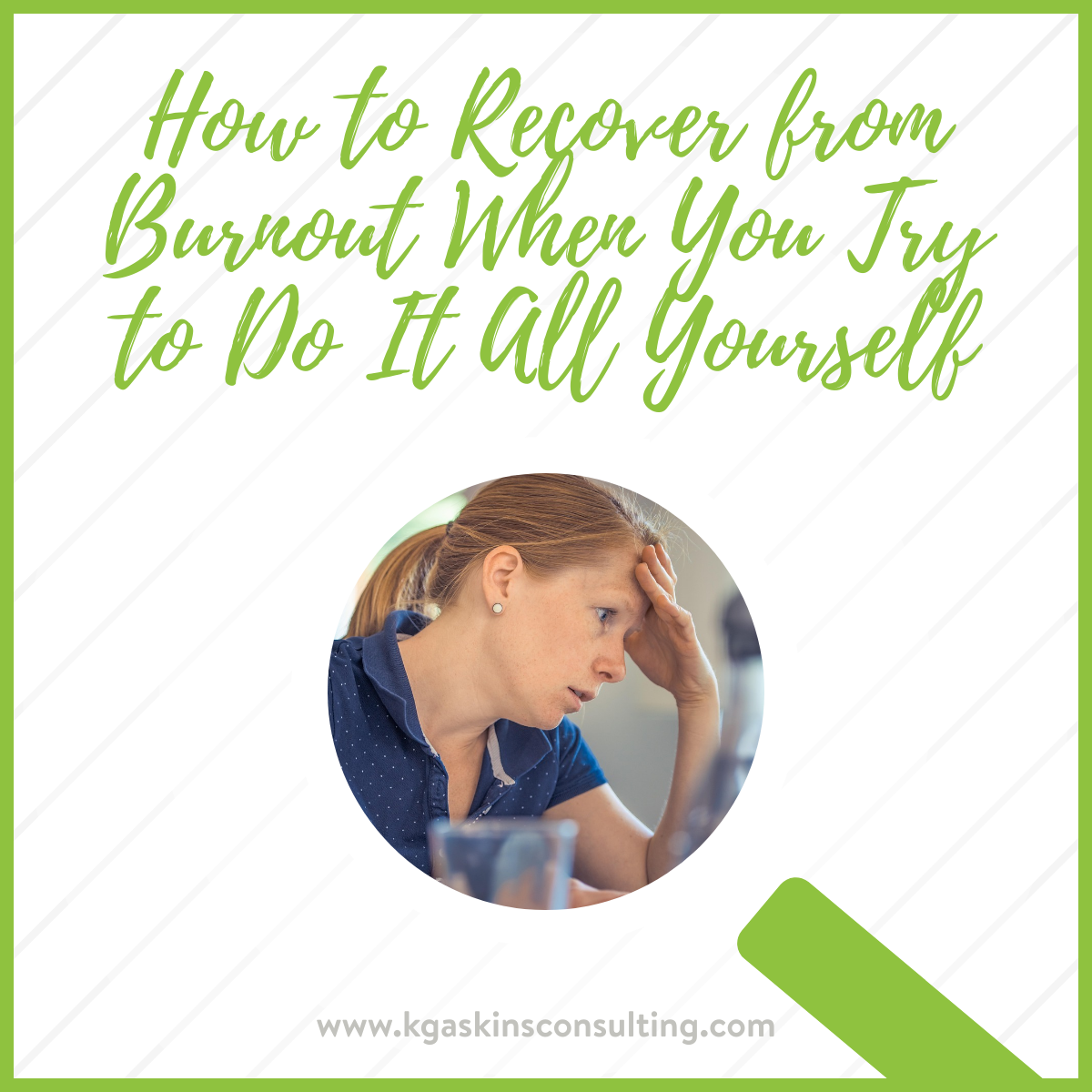
I am going to let you in on a secret that took me years, countless self-help books, and a painful journey through burnout recovery to finally understand we cannot do it all alone.
As a Gen X woman, I used to pride myself on being the ultimate problem solver. When things got tough, I did not reach out. Instead, I threw myself deeper into my work. I spent late nights researching how to do better, taking courses, reading self-help books, and implementing every strategy under the sun. I was the textbook definition of a "Chief Everything Officer."
And for a long time, I thought I was the only one struggling to keep all the plates spinning.
But as I began my own recovery journey, my eyes opened wide. In my coaching practice, clients came to me for business support, but beneath their professional goals, I saw the same pattern. They were exhausted, overwhelmed, and running on empty, yet they refused to ask for help. They wanted something different, but they did not know how to get there, and the idea of asking for support was entirely off the table.
Even today, with all the tools and healing I have experienced, I still have to catch myself before I hit a breaking point.
Why is asking for help the hardest thing for our generation of women to do?
The Roots of Our Silence: "Just Do It" and Glass Ceilings
To understand why we struggle to ask for help, we have to look at how we were raised. Gen X grew up in an era dominated by slogans like "Just Do It." We were conditioned from a young age to figure things out on our own, pull ourselves up by our bootstraps, and take on the world without complaining.
As we entered the workforce, we were the generation focused on breaking glass ceilings. We operated in a hyper-professional mode in which asking for help was not seen as collaboration; it was seen as a sign of weakness. We learned to work beautifully in teams, but we harbored a deep, underlying fear of ever being perceived as the weakest link.
So, we stayed silent. We took on more. We decided that survival meant carrying the weight of everything on our own shoulders.
The Trap of the "100/100 Rule"
This conditioning has followed us into midlife, creating an impossible standard I call the "100/100 rule."
Instead of operating on the traditional 80/20 rule, Gen X women try to give 100% of themselves to their work and another 100% of themselves to their lives outside of work. On any given day, we are trying to be there for everyone:
- Caring for growing children who still need us.
- Managing the care and logistics for aging parents.
- Supporting coworkers and employees.
- Maintaining households and relationships.
We want work-life balance, but we try to achieve it by multiplying our energy instead of dividing our tasks. We buy every planner, download every app, and try every time-blocking trick to squeeze more hours out of the day. To make matters worse, we are now more digitally connected than ever before. There is no off-switch. The boundary between work and life has completely dissolved, leaving us constantly on call for everyone else, and never available for ourselves.
The Illusion of the "Safe" Project
When the pressure of the 100/100 rule becomes too much, we reach a breaking point. This is exactly what happened to my client, Betty.
Betty was working for a company that was riding her incredibly hard, making her feel like nothing she did was ever enough. She was commuting an hour each way, working full days, rushing home to care for her kids, managing affairs for her parents, and then logging back on to work late into the night and on her days off.
She was physically sick from a lack of sleep and began questioning her own capabilities. She assumed the problem was her job, so she decided she wanted to start a side hustle so she could eventually walk away and set her own hours.
But notice what she did: to fix her burnout, she added a side hustle to her plate. She added more work to the 100/100 rule without giving anything else up.
Like many of my clients, Betty sought out coaching for this "safe" project, her new business. For Gen X women, asking for help with a business project feels professional and acceptable. Asking for help with our own health, well-being, and boundaries feels too vulnerable. It shines a spotlight directly on our perceived "failures." We hide behind the safe projects because putting ourselves first is a foreign concept.
Shifting the Spotlight: Bottom-Up Recovery

Early in my coaching career, I would focus on the safe business projects my clients hired me for because I was still navigating my own recovery. But as I healed, I realized we were treating the symptoms and ignoring the cause.
True healing does not happen by reorganizing your calendar or changing your job. It happens when we shift our focus from the external project to the internal person. This is why I trained as a Health and Well-being Coach and pivoted my approach to what I call "bottom-up recovery."
Traditional self-help is top-down—it asks you to use your mind to override your stress, using logic, willpower, and productivity tricks to force your way through. Bottom-up recovery does the opposite. It starts with the body.
- Tuning into the body: We begin by noticing our physical responses to stress. Do your shoulders tense up before a specific meeting? Does your stomach knot when you see a certain name on your phone?
- Resetting the response: We learn physical tools to reset the body’s stress response in real-time, teaching our nervous system that it is safe to slow down.
- The Personal Health Inventory: We step back and take an honest look at our lives across multiple dimensions, choosing just one area at a time to focus on.
- Making micro-changes: Instead of trying to overhaul our entire lives overnight, we make tiny, manageable adjustments.
Once you begin to feel physically and emotionally in control, only then do we start redesigning your life or your business.
How to Practice Asking for Help
If asking for help feels like an existential threat to your identity, you do not have to start by delegating half your workload. You can start with small, internal micro-changes.
First, give yourself permission to acknowledge how you are feeling. Admitting that you are tired, overwhelmed, or at capacity is not a failure. It is data. When you acknowledge your limits, you are not losing control; you are actually stepping into it.
Once you have built that internal foundation, you can practice your first low-risk, external ask. It can be as simple as using a script we practice in our sessions:
"I don't have the bandwidth to take this on right now. Can you handle it?"
Whether you are saying this to a colleague, a partner, or a family member, this simple phrase is a boundary. By planning ahead, identifying the support you need, and holding yourself accountable to your own well-being, asking for help stops being a crisis response and becomes a daily practice of self-preservation.
Reclaiming Your Power
If you take only one truth away from this today, let it be this:
It is okay to ask for help.
Reaching out to others is not a sign of weakness, and it is certainly not a sign of failure. It is the ultimate sign that you are finally taking true control of your life. You do not have to be the Chief Everything Officer anymore. You are allowed to step down from the impossible standards of the 100/100 rule and choose your own joy, health, and well-being first.
Ready to Step Down as the Chief Everything Officer?
If you are tired of keeping all the plates spinning and are ready to recover from burnout on your own terms, you do not have to do it alone. I work with Gen X women just like you to move past the "safe" projects and build a foundation of true, bottom-up well-being. Let's partner together to reclaim your energy, your boundaries, and your joy. Reach out today to schedule a conversation, and let's take that first, supportive step together.