
The Quiet Physical Cost of the Morning Inbox
Most people open their email first thing in the morning. Whether you do this at your desk, while getting ready for the day, or as an automatic routine while still lying in bed, pause and notice what is happening in your body.
Before you even read a single subject line, your body often reacts. You might notice a subtle frown, a tightening in your chest, or a bracing posture. Your body anticipates more tasks to add to your list, more demands on your time, and more people wanting something from you.
When your energy tank is already running low, this bracing often shows up through clear physical sensations:
- Jaw clenching and forehead tension.
- A racing heart or a sudden feeling of overwhelm.
- A quiet tightening in the shoulders or stomach.
- Holding your breath before the screen even loads.
Your body is not failing at productivity. It is accurately anticipating a heavy operational demand being placed on a depleted biological baseline.
When Logical Safeguards Fail
If you are carrying the weight of an executive, manager, or owner, you have likely tried the standard advice. You may have read that you shouldn't open your email immediately after waking up, or you might have tried setting strict calendar blocks to review messages.
For leaders running in survival mode, these logical safeguards rarely register.
When your body is operating in high gear to keep everything afloat, your physical system simply sees the inbox as an immediate source of additional demands. Because you don't currently have the biological bandwidth to process more friction, your body braces for the threat.
You cannot simply schedule your way out of a physical stress response. When your physical capacity is capped, the logic of a strict morning email rule collapses. We have to address the biology before we can rely on the operational strategy.
Establishing a Physical Baseline Before You Click
In my collaborative work with exhausted leaders, we do not start by auditing their calendars or mandating strict morning routines. Prescriptive rules often just feel like another heavy task to manage. Instead, we focus on establishing cues of safety so the body is ready to receive what is in the inbox.
This is a deeply individualized process. We start by tuning into what your body is signaling.
Before opening the inbox, make sure your physical system feels grounded enough to handle incoming requests. For some leaders, this looks like taking a moment for quiet, rhythmic breathing to drop their shoulders and settle their chest. For others, it is about resting their hands on a solid surface or holding a grounding object like a basalt stone to bring their attention back to the present moment.
The priority is simply signaling to your body that you are safe in the present moment before you invite the outside world in.
The Trap of the Universal Magic Answer
Once you feel grounded, you may reach for a mainstream productivity hack to solve the inbox problem permanently. Mainstream advice will tell you to buy a new digital dashboard, hire a virtual assistant, create an AI agent, or adopt an aggressive time-blocking method.
These are not inherently bad tools. However, when prescriptive, one-size-fits-all advice is handed to a leader locked in active survival mode, these additive habits just become another metric to fail at.
As outlined in my formal KGC Grounded Triad Governance & Trap Prevention framework, reaching for complex software when you are depleted usually triggers the App & Dashboard Trap, introducing visual noise and cognitive drag. Similarly, hastily hiring an assistant triggers the Management Overhead Trap, creating immediate short-term friction when you have no bandwidth to train them.
Let us look at why the most common email hacks usually backfire when your system is depleted.
The Misunderstood Goal of Inbox Zero
Perhaps the most common prescriptive trap is the pursuit of "Inbox Zero." For a leader already holding up the skst, hearing the name of this framework can make you tense up. The word "zero" sounds like an absolute mandate. It triggers an immediate bracing response: jaws clench, and shoulders tighten because the brain interprets "zero" as a demand to completely clear a never-ending flow of requests.
Standard corporate logic has completely misunderstood the system's intended intent. It was originally designed as a processing framework to help you make swift decisions about incoming information. Today, hustle culture has twisted it into a visual performance metric, treating an empty screen as the ultimate sign of a successful, organized leader.
The goal was not to have an empty screen.
When misunderstood this way, Inbox Zero treats your cognitive bandwidth as an infinite resource and assumes that you must process, categorize, or resolve every demand placed upon you immediately. For a leader already running on manual adrenaline, forcing yourself to clear every message only deepens your biological debt. It turns your inbox into a relentless performance metric.
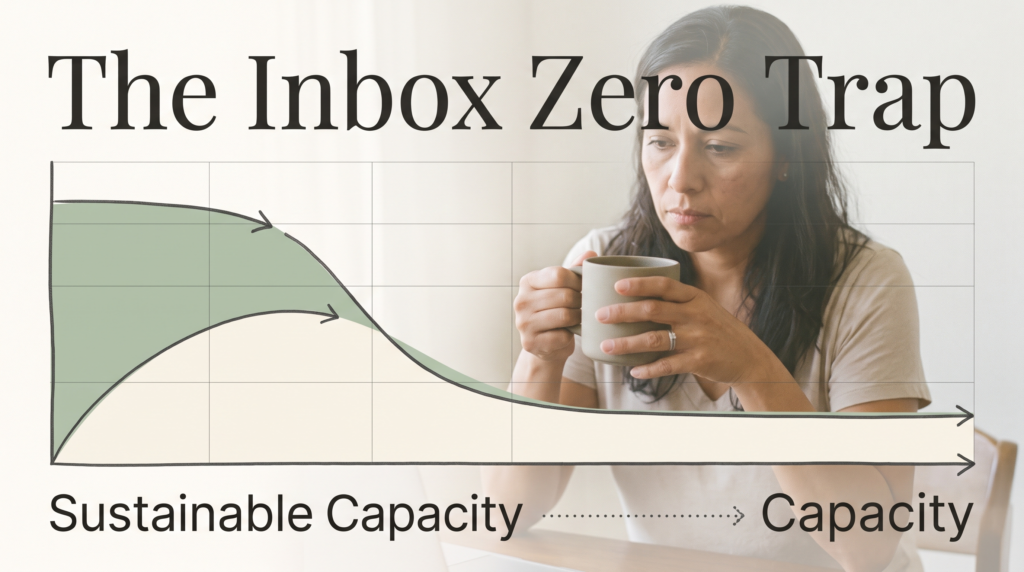
Instead of aiming for an empty screen, aim to build sustainable capacity. The objective is to have a clear decision threshold so you know what requires your executive focus today and what can be deferred, allowing your business to hold its own weight. You can step away feeling entirely sovereign even with fifty unread emails remaining. The system doesn't need to be complicated, and you can use what you've got on your nervous system that feels safe.
Designing an Operational Boundary You Can Trust
Your biology needs to feel safe first, but operational clarity is what sustains that safety. The exact boundary you need depends entirely on the weight you are carrying. A solo founder requires a very different structure than a corporate executive.

For the Solopreneur: Creating Self-Holding Rules
When you run a business alone, you are the manual bottleneck. Immediate response habits train clients to treat you as an emergency room. To protect your limited cognitive bandwidth, you must build simple rules that carry their own weight.
- Build a Communication Blueprint: You do not need complex IT systems. Use simple auto-responders to set explicit boundaries so clients know exactly when they will receive a reply. This structural default holds the line while you recover your baseline strength.
- Create Low-Tech Sorting Rules: Before introducing new software, create basic sorting folders in your existing email provider. Start small. Process only emails from known active clients first, and save newsletters or cold pitches for a dedicated time.
- Cap Your Daily Decisions: Treat your human energy as a strict, non-negotiable baseline. Decide before you open the inbox how many complex problems you have the bandwidth to solve that day. If your capacity is capped at three major decisions, any email requiring a fourth decision gets deferred.
For the Corporate Leader: Systemic Blackouts and Server Delays
If you are leading a team within a larger organization, you have systemic leverage. You don't have to rely purely on personal willpower to stop the digital flow; you can engineer the environment to protect your team's focus capital.
- Establish Organizational Blackout Periods: Work with your IT department to configure email servers to deliver only internal messages during specific working hours. If an email is sent at 9:00 PM on a Friday, the server holds it and delivers it at 8:00 AM on Monday.
- Enforce True Disconnects: This is exactly as I noted in my previous article about why wellness apps are not enough. You cannot give your employees a subscription to a meditation app and expect it to fix systemic burnout if the company email server is still pinging their phones through the night. The organizational structure itself must hold the boundary.
- Anchor the Day with Physical Hardware: When the blackout period begins, create a physical circuit-breaker in your home office. Place a reversible wood boundary tile on your desk to visually signal that you're logged off. Translating a digital boundary into a tactile object helps your brain register that the work is truly paused.
Reclaiming Your Baseline
Whatever structure you choose, the key is knowing that you have a plan. If you begin to feel that familiar bracing return to your jaw or shoulders, you step back. By aligning your physical capacity with clear operational boundaries, you ensure your daily rhythms can finally carry their own weight.
If you are tired of running your life and enterprise on continuous adrenaline, it is time to establish a new foundation. I invite you to start with the Free 3-Day Somatic Reset to experience immediate biological settling. When you are ready to design your operational architecture, you can schedule a zero-pressure 15-Minute Curation Briefing to discuss how the CEO Wealth Operating System or our Executive Focus & Boundary SLA Audits can resolve the specific structural friction holding you back.